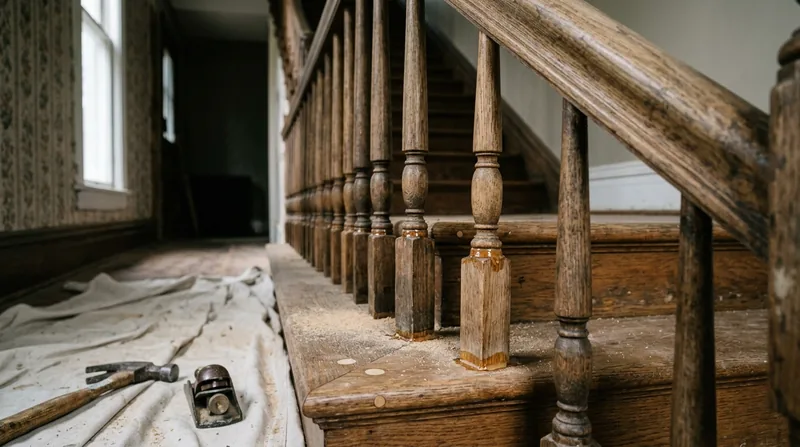




Stair & Railing Repair in Louisville keeps the staircases in our Victorian mansions, Craftsman bungalows, and mid-century homes safe and functional. Louisville's older residential stock, from the pier-foundation shotgun houses of Old Louisville to the brick cottages of Schnitzelburg and the frame Craftsman homes in the Highlands, relies on stairs that endure decades of foot traffic, seasonal wood movement, and the region's freeze-thaw winters. Squeaky treads, loose balusters, worn stringers, and sagging railings are not cosmetic problems. They signal movement in the stair structure itself, and that movement compounds each season. We repair and rebuild staircases, restore period railings, and install code-compliant handrails. Unlike replacement, repair preserves the character of your home while addressing the real mechanics of the failure.
Why Stair & Railing Repair Matters in Louisville's Older Homes
Louisville's building stock is defined by age and wood construction. The freeze-thaw cycle that runs from November through March stresses wooden stair stringers, treads, and newel posts. Water seeps into joints, wood swells and shrinks, fasteners loosen, and the staircase begins to move. In Germantown, the Highlands, and Crescent Hill, where Victorian and Craftsman homes dominate, original stairs built from solid white oak or tulip poplar are still in service, but they need intervention. A loose baluster is not a minor repair, it means the newel post is moving, or the balustrade is separating from the stringers. A squeaky tread often signals a tread-to-stringer connection that has failed, and that failure accelerates with each step.
- A squeaky or bouncy tread indicates the fasteners between tread and stringer have loosened or failed, and the wood itself may be checking with age.
- Loose balusters or a wobbly newel post mean the balustrade is separating from the stringers, a safety issue that worsens with vibration and foot traffic.
- A cracked or split stringer is common in 50-plus-year-old stairs and reduces the structural support for the entire run.
- Worn or cupped treads create trip hazards and signal wood movement that can affect the integrity of the entire staircase.
- Railing code compliance is required when you repair stairs: balusters must be spaced so a 4-inch sphere cannot pass, and handrails must meet current building code height and diameter requirements.
Ignoring these problems does not make them stable. Each season of freeze-thaw and humidity cycling deepens the damage.
Key info: Louisville and Jefferson County building permits are required for stair or railing alterations. Contact the Louisville Department of Permits, Licenses & Inspections to confirm requirements for your project before work begins.
How We Repair and Rebuild Stairs in Louisville
Our process begins with a detailed inspection of the stair structure. We identify which parts are sound and which require repair or replacement. Stairs are made of stringers (the angled supports), treads (the horizontal steps), risers (the vertical panels), balusters (the spindles), and newel posts (the corner supports). Each component can fail independently or in sequence. We repair what can be saved and replace only what the wood and the code demand.
- We inspect the stringers for splits, checks, rot, and movement, and test all fasteners connecting treads and risers to the stringers.
- We evaluate each tread and riser for cupping, warping, movement, and wear, and confirm tread depth and riser height meet code (7 to 8 inches for tread depth, 7 to 10 inches for riser height).
- We assess the balustrade, testing balusters for looseness, checking newel posts for movement, and confirming all railings meet current code spacing and strength requirements.
- We develop a repair plan that specifies which parts can be reinforced or refastened and which must be replaced.
- We execute the work, using traditional joinery, sistering (doubling), or replacement as the wood and code demand.
- We test the finished staircase for safety, movement, and code compliance before final walkthrough.
A typical example: a 1950s brick ranch in Middletown with original wooden stairs develops a squeaky third tread and a loose baluster on the landing. We inspect and find the tread fasteners have corroded and pulled free, and the newel post has shifted 0.25 inches from seasonal movement. We remove the tread, drill out the old fasteners, and reset the tread with new screws and construction adhesive. We reinforce the newel post connection and reset the loose baluster. The staircase is now stable and will serve another 50 years.
Local example: Craftsman homes in the Highlands often have original solid oak stairs with hand-turned balusters and newel posts. These stairs are worth preserving. We repair and reinforce the structure without replacing the character-defining woodwork. See our finish carpentry work for details on period-appropriate restoration.
Methods and Techniques for Stair & Railing Repair
| Repair Method | Description | Best For |
|---|---|---|
| Refastening & Reinforcement | Remove old fasteners, clean joints, and reinstall with new hardware and adhesive to restore tread-to-stringer and baluster connections. | Squeaky treads, loose balusters, minor movement from seasonal wood shift. |
| Sistering | Bolt or screw a reinforcement member (sister board) alongside a cracked or weakened stringer to restore load capacity without replacement. | Cracked stringers, split treads, structural weakness that does not warrant full replacement. |
| Tread & Riser Replacement | Remove damaged treads or risers and install new lumber or engineered material, matched to the original species and profile where possible. | Cupped, warped, or rotted treads; worn risers; code-required safety updates. |
| Baluster & Newel Replacement | Replace damaged balusters and newel posts with new lumber, matched to period style where the home is historic or Craftsman-era. | Split balusters, rotted newel posts, loose or broken railings, code-compliance updates. |
| Handrail Installation | Install code-compliant handrails on one or both sides of the staircase, meeting current diameter and height requirements. | Stairs without railings, attic access stairs, basements, or when code updates require upgraded railings. |
Each method is chosen based on the wood condition, the structural demand, the age and character of the staircase, and local building code. We do not replace what repair can fix.
Stair & Railing Repair Cost in Louisville: What to Expect
The cost of stair and railing repair in Louisville depends on the scope of work, the condition of the wood, and the materials required. A simple refastening job on a squeaky tread or loose baluster starts at around $600 and may take one to two hours. More complex work, such as sistering a cracked stringer or replacing multiple treads, typically runs $1,500 to $3,500 depending on the number of stringers, the length of the run, and whether the original wood can be preserved or must be replaced. A full staircase rebuild or a major structural repair can exceed $5,000, and those projects always require an on-site estimate.
Several factors move the cost. The number of stringers (most stairs have two, but some have three) affects labor and material. The length of the run (a short basement stair is cheaper than a full two-story staircase) changes the scope. Whether the stringer is cracked or simply loose changes the repair method. Whether you need new handrails or code-compliance upgrades adds cost. The species of wood and the availability of matching lumber (white oak and Douglas fir are more common than specialty woods) affects material pricing.
We recommend getting 2 to 3 estimates so you understand the range. See our full pricing overview for typical ranges across our services, and call us at (502) 586-4642 for a free, no-obligation estimate specific to your staircase.
What to Look for When Hiring a Carpentry Contractor Near Me in Louisville
Choosing the right carpenter for stair and railing repair means looking beyond price. Your contractor should be fully insured, should be able to explain the pathology (why the stair is moving or squeaking) in clear terms, and should be willing to repair rather than reflexively replace. Ask whether the same carpenters who estimate the job will execute it. Ask for references from previous stair repairs, not just new construction. If your home is historic or in a protected district, confirm that your contractor understands period restoration and can source matching materials.
Permits are commonly required for stair alterations and railing work. Contact the Louisville Department of Permits, Licenses & Inspections to confirm what your project requires before you book. If you live in an HOA community or in a historic district, check whether additional approvals are needed. A good contractor will help you understand the permitting process, though you are responsible for obtaining permits.
When you call for an estimate, ask about the inspection process, the timeline, and how the contractor will document the work. A free estimate should include a walk-through of the staircase, a description of the issues found, and a clear breakdown of the repair plan. Contact us at (502) 586-4642 for a free estimate, and we will respond within 24 hours. We serve Louisville, Jeffersontown, St. Matthews, Middletown, Prospect, La Grange, and surrounding areas throughout Jefferson and Oldham counties.
Stair & Railing Repair in Louisville: Pricing Guide
| Service | Price | Details |
|---|---|---|
| Simple refastening and baluster reset | Starting at $600 | Loose balusters, squeaky treads from fastener failure, minor balustrade tightening, one to two hours labor |
| Tread replacement or sistering a stringer | Starting at $1,500 | One or two treads replaced, cracked stringer reinforced, or newel post stabilized, includes materials and labor |
| Multi-tread or full balustrade repair | Starting at $2,500 | Three or more treads replaced, multiple balusters renewed, or major structural reinforcement, full staircase assessment included |
| Full staircase rebuild or major structural work | On estimate | Complete stringer replacement, major rot or damage, two-story or complex geometry, or extensive code-compliance upgrades require site inspection |
| Travel and estimates | Included and free | No mileage or call-out fee in Louisville and surrounding areas, free estimate within 24 hours of your call to (502) 586-4642 |
Indicative pricing, the exact cost depends on square footage, finish, and site access. Free personalized estimate within 24h at (502) 586-4642.


